Posts

Design Phase: Interactivity
Image
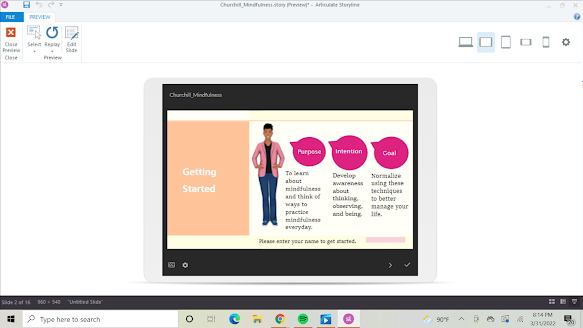
Thinking about creativity. Where can I draw inspiration? What have I learned as an ID with this module? For one, how can I introduce a topic in a way that feels fun and interactive, but still meaningful? Answer: Think about video games.  "The focus of learning is on completing challenging tasks that are typically complex and change over time." (Dickey 2005) The focus of my module is developing mindfulness. Then, in the beginning of the course I just want to get the learner's feet wet with the course. Maybe test their comfortability with interactions, something simple like asking the user to insert her name on the introductory slide. learner enters name, will display name again later How the strategy behind video games compliments work for instructional designers (Dickey 2005). Video games are primarily for entertainment, but many of their functions can be useful in an educational arena as well.  Dickey also mentions how emerging media keeps IDs on their toes, as it were. ...
PowerPoint Corruption

The Cognitive Style of Power Point: Pitching Out Corrupts Within   Oh, Powerpoint. Death by Powerpoint is a real issue. The best way to bore your audience is that tried-and-tired presentation by means of reading a collection of slides with simple graphics. As Tufte (2006) mentions, its been the standard among corporate and government businesses that includes bulleted lists and lacks overall quality. The article goes into discussing how analytical data is trunked out on a PP through what he calls slideware. What's interesting is how he actually analyzes the structure of the slides. The author goes through the typical slideware protocol and addresses certain nuances about why this is a poor format. For instance, the "exposing the first line... then the second line... and the final line" was a great visual. Everyone has been there. The issue, then, is that these Powerpoint presentations are not statistically relevant to their audience or in driving information. In fact, the ...

Design Updates

Image
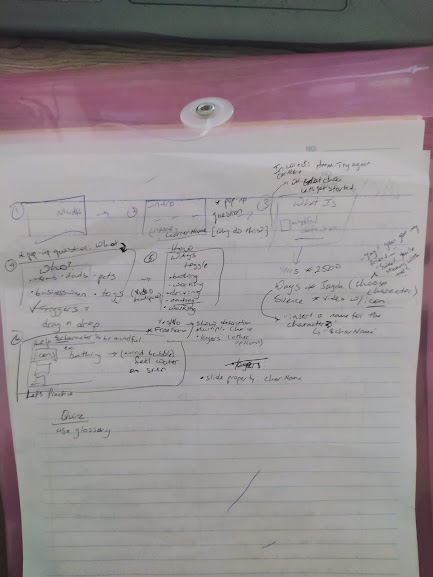
Mar 7: Learn about variables adding a name  using a name %name% = project variable Formatting!!! 😭 Design question: How to: - remove the menu from the player view - confirm the menu isn't showing in the player view - remove the auto-advancing features. I think I've built in animations somewhere but I can't figure it out ID Reflection: I'm spending hours  on what seems to be small, trivial details. That's the most frustrating part. Like, for instance, sticking pictures into a box so that they're all cohesive and pleasant to the eye. * best practices:: change name of triggers/layers/features in case you want to refer back to them later ID trick: Use the "notes" section in the slide to jot notes about ideas for slide ---- Who Can Practice slide (notes) this slide will feature drag-and-drop.  the user will add the icons on the left to the right. if they’re incorrect, a “”No,__user name, that’s incorrect” can appear and bounce back into place can “Everyone...

Layout of Module

Image
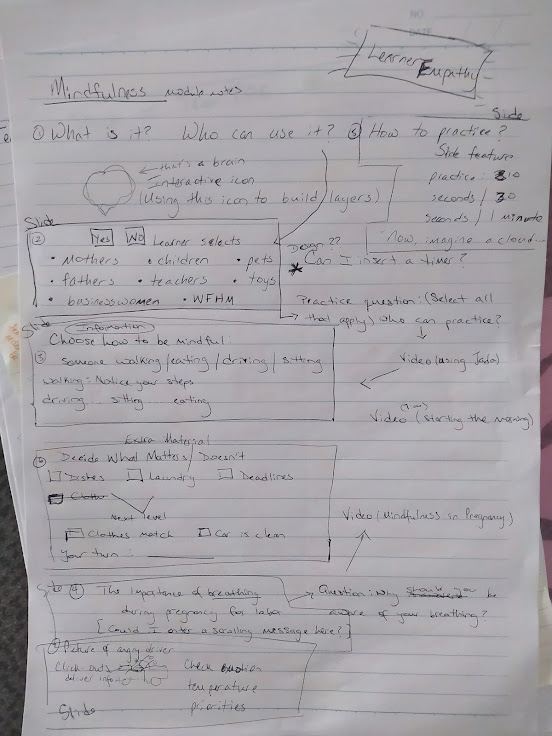
  module layout

Storytelling

Image
How does developing learner empathy help me design an optimal learner experience?  Parrish (2006) calls it a necessary skill for IDs, a "dramatic rehearsal". The design story calls for a character, who the ID follows along their instructional journey. In first-person viewpoint, describe the experience of the learner including their atmosphere, thoughts, external factors.  Quick record (don't spend much time on details) Present tense Inhabit the learner Use empathetic imagination Design perspective: Who is my learner? A working mother who wants to manage her stress better. What's her story? Inhabit the learner. When does she take the course? Why? With what expectation? What are her surroundings when taking the course? Describe her disposition. When does it benefit me most in this project to create the design story? Answer: During the Design phase (Parrish 2006) Learner: Pam. She's a work-from-home mother to her two-year-old daughter while also managing an online bu...

Week 5 - Empathy

Image
Topic: Mindfulness Target audience: Everyone? Can I focus on people who self-identify as overwhelmed with life and managing the several areas it involves? Mothers How to gather data? Informal survey through messaging. Poll people I know about their perspective of mindfulness. Question: How do you define/understand "mindfulness"? Design Methods Persona  Because we naturally relate to other people People typically share similar interests and lifestyles that influence their attraction to a product Without a persona, designers/design team make assumptions or design for themselves - Problematic!  Gives a target to focus on User journey mapping Visualize the steps a user will take to accomplish a goal 1st: Whose journey is it? Using the data collected about users' characteristics, what do I want them to accomplish? 2nd: Plot the stages of the experience using a timeline Identify the 6 aspects: Stages, Activities, Thoughts and Emotions, Touchpoints, Pains, Gains... as well as th...

Mindmapping "Mindfulness"

Image
 What do I want the learner to gain from this course? An understanding of mindfulness and how to practice it daily. Why do I think mindfulness is an important concept to learn about? There is not one person who functions normally in everyday society that doesn't feel the pressures of day-to-day responsibilities and tasks. To manage all areas of life more succinctly, mindfulness opens you up for balance. How can someone practice mindfulness? That's the central idea of this course. Perhaps in this course I'm not teaching the learner what  mindfulness is, but rather using interaction to let them come to a conclusion. Then at the end of the course, they would compare their definition of mindfulness with the one I've introduced in the beginning. Layout: One interactive slide is an animate image of an enlarged brain. Coming out of the brain are cloud thoughts. The cloud thoughts are clickable. Inside them, they dig deeper into each concept. It's called a labeled graphic i...